Showing posts with label GMO. Show all posts

Friday, March 11, 2011

Friday's Food Finds

All week I am all over the Internet blogging about food, commenting about food, reading about food and finding tons and tons of stuff! I simply can NOT dedicate a single post to each individual find, so here's what I am going to do: I am going to give you a CliffNotes version of some foodie finds that I think you might all be interested in, so you have stuff to read and tinker with over the weekend! Here it goes:

Food Web Sites and Tools
  • two foods Here is a neat little tool for food nutrition comparisons. Let's say you are faced with almonds and cashews and you don't have a particular craving for one over the other, but you are curious about the nutritional facts run-down for each. Enter two foods. Type in each type of nut and click "Compare!" here's what you'll see:

    Casabella Silicone Cutting Board, Set of 4
  •  Casabella Cutting Boards (set of 4) One concern in a kitchen is cross-contamination. To be honest, this is not something I ever thought of before I started watching all these chefs on TV - I had one cutting board that I washed in between uses. I am not a big fan of lots of stuff cluttering up my kitchen, so when I found these cutting "boards" I was super happy. They are super skinny, flexible and take up less space than my old cutting board! They have to be hand washed, but their bright colors and cute graphics make them so easy for me to use and keep straight! If you are looking into purchasing separate cutting boards for poultry, beef, fish and veggies, I highly recommend this very durable and affordable option!
Food Reads
  • The perils of food nutrition and research This post from Marion Nestle on her Food Politics blog addresses issues that arise in all arenas of research - poorly designed studies, misread data and highly elevated claims. I taught Statistics before going on my medical leave and often take for granted that people can decipher the difference between a good study and one that can be thoroughly misleading. It is unfortunate that our media does not filter this for us. All "studies" should first be questioned: Who ran this study? Why did they run this study? How did they collect this data? ...I think you get the idea. For now I will leave you with Dr. Nestle's article, but we shall revisit this topic on the Searching for Sustenance blog!
  • Eco-farming Could Double Food Output of Poor Countries, Says UN One of the huge arguments for industrialized agriculture is that it feeds the world. It is argued that the technology brought to the land is, in many places, the only hope. Well, the UN brings up some contrary evidence reported here. Excellent information.
Good Food (Recipes)
  •  Raw Chili Cheese Fries My husband and I discovered our deep connection with chili cheese fries on our first vacation together to Walt Disney World - they were amazing! Since seeing the light about the insanity of our ways (we were eating them all the time after that vacation), we have cut out this delectable treat. When I found Poppy's recipe from her first adventure at a Raw Foods Class this week on her From Fried Chicken to TOFU blog, I knew I found something I would have to try and share.  So, I am getting my shopping list together, but let us know how s goes if you get to it first!
  • The Homemade Twix Bar (...because I can't). OK, OK I know... I am usually preaching all wonderful kind of healthy stuff, but this would be HOME-MADE - that has to count for something! And I would really like to live vicariously through you! Twix are one of my favorite bars and with my dairy-free/gluten-free life, I have also been Twix-free! Kim at Incandescent Blue Flame is the one who exposed me to this torture earlier this week. I forgive her, but it was rough at first ;)
Food FiGHTS
  • Rally for the Right to Know on March 26, 2011 in Washington, DC  is getting organized. Millions Against Monsanto - RALLY FOR THE RIGHT TO KNOW - Genetically Modified Foods need to be labeled! Saturday, March 26, 2011, 11am - 3pm on The White House Sidewalk. The mission: Spread awareness of genetically modified foods and Monsanto's increasing monopoly of our foods. To get involved, either visit their facebook page, or e-mail millionsagainst@gmail.com
  • Protect Food & Water Safety Funding
Do you have a food website, tool, food read, recipe or food fight you think I should check out and share with the readers of Searching for Sustenance? If so e-mail me at BlogWithNV@gmail.com!

Saturday, February 26, 2011

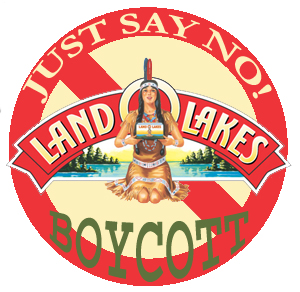
Why Boycott Land O'Lakes?

Image from the FarmWars blog
Get out your grocery lists.

Grab a pen or pencil.

You have to cross off some stuff on your list and you have to do it NOW.

You must stop buying any products from Land O'Lakes.

OK, I know you're thinking that I've completely lost my mind and you don't want to take any rash action based on my word alone, so let me tell you why this is something that YOU will WANT to do yourself. Here is some information I just read both on the FarmWars blog and Foodmans Blogging for the Future:
"To produce its Round-Up Ready Alfalfa seeds, Monsanto partnered with a company called Forage Genetics International, which is a wholly owned subsidiary of Land O’Lakes dairy co-op. That’s right, Land O’Lakes stands to make a fortune from polluting our food supply with untested and unlabeled GMOs."
So there has been a call to action, an action that may actually make some waves in this economy in a way that our protests, petitions, and letters to Washington have failed to accomplish - a boycott of the purchase of Land O'Lakes products. And so that the impact of the action is not mistakenly blamed on our suffering economy or some other financial issue, it is also recommended that we just come right out and tell Land O'Lakes what we are doing!
"Send Land O’Lakes and other companies a clear message:  HAY you — We’re FED UP with GMOs in our food supply!
And to make sure Land O’Lakes knows why its sales are down, contact its president and CEO Chris Policinski and let him know you won’t be buying Land O’Lakes products anymore because you don’t want genetically engineered food or animal feed:
Chris Policinski
President and CEO
Land O’Lakes
4001 Lexington Avenue
Arden Hills, MN 55126-2998
651/481-2222"
In addition, some fired up foodies have decided to share their feelings on the Land O'Lakes Facebook page. Not a bad idea if you ask me since that message will not only be read by Land O'Lakes people, but also customers who may not know about the partnership with Monsanto.

Do you still have that grocery list? Have you crossed them off yet? In the end, it is up to you, of course. However, if you believe in this cause and decide to boycott Land O'Lakes (as I will be doing - I just informed the husband before this writing), then please be sure to share your feelings with others you care about.

For some further information on GMOs:

Are you ready to answer a call to action in the month of March? 
Check out Where Are All My Hummingbirds? A Call To Action to see what challenge the Searching for Sustenance blog has planned!

    Thursday, December 9, 2010

    Dr. Oz and the GMO Debate Part 3

    In the first part of The Dr. Oz Show Segment on GMO foods, the discussion began about non-GMO food labels and a short education of what GMO actually means. In the second part, Dr. Oz began a discussion with three expert panelists discussing the viewpoint of both proponents and opponents to the GMO debate. Here, we will take a lok at the third and final part of the segment.

    Dr. Oz Takes the Conversation International and Then, Back to Labels
    Genetically Modified Foods, Pt. 3 (The Dr. Oz Show video clip is 4 minutes and 11 seconds long)

    Dr. Oz continued to probe the one proponent of GMOs on his panel, Dr. Pamela Ronald, by taking a look at the international community. He raised a pretty good question.
    Why are GMO crops banned in a number of  European nations?
    image from The Dr. Oz Show originally aired on 12/7/2010
    This is the point where I always start to take sides. Perhaps I am being naive in some way, but why would an entire country ban a farming practice if it was safe? Dr. Oz asked this question - I just wished some scientist from one of these countries could have been there to answer. All we can do is speculate.

    And then Dr. Michael Hansen, piggy-backing off of Dr. Ronald's statements about using the best science for determining GMO safety in part 2, piped in and said what someone needed to say during this entire debate:
    "One thing that should be pointed out is that we do need more science... in this country... the FDA does not require any extra safety testing at all."
    This, of course, had me thinking, again, about that pesky Food Safety Bill and whether or not it truly was up to snuff. I am going to have to go back into that one and see if there are any things I would like to speak out about before it makes it to the House of Representatives. 

    To finish the segment, the conversation turned back to labeling and what the benefits are and what the drawbacks might be. They each can be summarized quite simply. The labeling of GMOs benefits us with informing us, we then have the opportunity to use our "capitalist vote" to decide what types of food we wish to support and, ultimately, consume. The drawbacks of any labeling system are two-fold; (1) who does the labeling, and (2) the limitations of the labeling process. Even the Non-GMO Project we looked at in Part 1 of this series, clearly states on their website that they can not guarantee that the products labeled non-GMO are 100% GMO free.So we are left, once again, making a leap of faith, only this time, when armed with a label the leap should be over a puddle, not the Atlantic Ocean!

    My Final Thoughts About The Dr. Oz Show's Panel on GMOs

    First of all, I am extremely happy that Dr. Oz devoted a segment of his show to this topic. I wish it were the entire episode, but there was a lot of info in this half of the show, regardless. When I first found out about this show, I was excited at the prospect of hearing Dr. Pamela Ronald's viewpoints, but, due to lack of time I feel my curiosity is not yet satiated. I think, due to this fact, Tomorrow's Table is going to be on my reading list. I am also curious about Dr. Michael Hansen's work and will be on the lookout for more word from him, as he seems to be a rational man opposed to GMOs, rather than an extremist opposed to GMOs (I believe there is a significant difference).
    For now, personally, I am still going to try to maintain a GMO-free diet when possible on my search for sustenance. I have two chronic conditions, one of which is idiopathic (unknown origin) in nature and I don't believe I have the body or the time to waste waiting for science to decide which way to go. So, unless some GMO seed is going to cure Intracranial Hypertension or eradicate Crohn's disease from my family tree, I'll take my genes unmodified, thank you.

    Resources, Links & Further Info:

    Dr. Oz and the GMO Debate Part 2

    After Dr. Oz introduced GM (genetically modified) foods to the audience, as well as some of his concerns about them in Part 1 of this segment of show, he introduced the three expert panelists invited to speak on the topic of genetically modified foods.
    •  Jeffrey Smith, author of two books on the subject of GM foods,
    • Dr. Michael Hansen, who works for Consumer Reports and has studied GM foods, and
    • Dr. Pamela Ronald, a Plant Pathologist and author of the book and blog of the same name: Tomorrow's Table
    Dr. Oz also mentioned that he extended an invitation to someone in the Monsanto company, but they declined, providing a statement, of which he shared this bit:
    image from The Dr. Oz Show episode originally aired on 12/7/2010

     Part 2 of Dr. Oz's GMO Segment - The Debate begins
    Genetically Modified Foods, Pt. 2 (this video clip is 5 minutes and 29 seconds long)

    As Dr. Oz began to engage each of the panelists in their viewpoints of the place GMO foods have in our world and in our diets, he paused to give voice to the major questions raised by the proponents and opponents of this technique of food/crop development. I think it is very important to take note of them, here, again:
    image from The Dr. Oz Show episode originally aired on 12/7/2010.
    What struck me as this graphic hit the screen was the question marks. So often, being exposed to extremist views in a topic of debate, it is easy to forget that they actually belong there. Are these benefits? Are they always true? Are none of these things possible with non-GMO food? Why does it provide a cheaper food supply? How do they improve the lives of farmers?
    More questions rose the more I let these settle...

    image from The Dr. Oz Show episode originally aired 12/7/2010
    And then the opponents' questions hit the screen. Where is the evidence of each of these harmful effects? I have heard them all before, it is one of the reasons I avoid GMO whenever possible, but when I heard about them, there were no question marks. I began to wonder, what is the flip side to this story, sure Monsanto did not show, but what does Dr. Pamela Ronald have to say? I would like to hear both sides to the story and then make my decision.

    I had really high hopes for this episode when I first heard about the panel of GMO experts - for once, I thought, I'll be hearing both sides of the story, even if it is on a short segment of a show! However, I was disappointed by the seemingly one-sided nature of the show (even if it did lean in my direction). Jeffrey Smith spoke of all of the things that he learned through his research for his books (he worked with doctors and scientists, he is not one himself). His claimed that evidence was found to for all of the maledictions in the graphic above, he actually said at one point that all doctors should, "prescribe a non-GMO diet to all of their patients." When he was done, Dr. Oz asked Dr. Ronald to chime in. She claimed that all of Mr. Smith's evidence has been refuted and listed a number of websites (bioforitifed,org, ucbiotech.org and academicsreview.org) to go to in order to see those studies. I thought to myself, "Here we go. This is going to be good," and then Dr. Oz cut her off! I was shocked. He said people don't want to hear about websites, "...they think either you're full of it, or Jeffrey's full of it." That's true.

    Her response was spot on, she said, "...Science does not make policy, but we need to make policy based on the best science..."and then got in one more dig that Mr. Smith is not a scientist.

    The question in this debate: WHAT IS THE BEST SCIENCE?

    I agree with Dr. Ronald. I understand the suspicion of Jeffrey Smith's results, but what about Dr. Hansen?


    Books written by people on the show:
     

    Wednesday, December 8, 2010

    Dr. Oz and the GMO Debate Part 1

    On the December 7, 2010 episode of The Dr. Oz Show, the topic of genetically modified foods was addressed and some excellent questions were raised. If you missed the show, don't fret, the show has put the video segments on their website for all to see and share in three parts. I decided to also approach my blog discussion in these three parts, as dealing with it all in one post would be an incredible amount of information to digest in one sitting.

     Genetically Modified Foods, Pt. 1 (video clip is 4 minutes 34 seconds long)
    Dr. Oz's intro to GMOs and the Non-GMO Project


    Dr. Oz began his show about genetically modified foods by saying the fact that we hadn't noticed the "Non GMO product" label on the bread he displayed bothered him. Well, Dr. Oz, it bothered me too. I am a label looker! I am constantly searching for evidence of a food-stuff's value and I had never seen the label he showed before the airing of his show! I immediately took note of the website on the label and got to investigating.


    The Non-GMO Project

    The label to look for.
    I am still trying to figure out how I missed this one. Here's a blurb from the Non-GMO Project website explaining who they are:
    The Non-GMO Project is a non-profit organization, created by leaders representing all sectors of the organic and natural products industry in the U.S. and Canada, to offer consumers a consistent non-GMO choice for organic and natural products that are produced without genetic engineering or recombinant DNA technologies.
    It sounds like a great idea, in fact, it sounds like exactly what I've been looking for, so, I asked, "Where the heck is it?" The website is very useful to this end as well as it provides links to find participating products sorted by brand, category and/or name. They also provide a link to find participating retailers by location and/or name.

    While this is a step in the right direction, it is important to know how the non-profit organization determines which products get the label. In the Understanding Our Seal portion of the website, a brief explanation is given. I will summarize even further:
    • every ingredient is tested, but not necessarily every product.
    • testing happens at various stages in product development.
    • the test must indicate that the ingredient is below 0.9% GMO, which is evidently in line with the European Union laws.

    Finally, if you are impressed, perhaps you feel that you will not buy GMO products now that they are labeled and you are informed. When asked the same question, 80% of the studio audience at The Dr. Oz Show said they wouldn't. The non-GMO Project wants to hear that commitment from you - they provided the Non-GMO Consumer Pledge on their website.


    Before We Get Into the Panel & Part 2

    While you are making that commitment, you may also want to do your part to stop new genetically modified foods from making it to the market. I have written about various opportunities to contact your representatives about genetically modified fish and organizations to follow for the latest information in the "food fight",  let today be the day you take one of those actions!


    Next up: From The Dr. Oz Show - Genetically Modified Foods Part 2: A Panel of Experts on Both Sides

    Tuesday, March 16, 2010

    BIG Questions... with MY Answer, so far

    So while I am home sick (again!) today, I am thinking about lots of food conversations I had at work yesterday and over the remainder of my weekend (well, as much as one can think about things after waking up at 2pm!). Lots of information has been shared, lots of questions have been asked and in the process both my curiosity and skepticism have been piqued again... One thing keeps itching at me and clawing at me: being healthy and eating is becoming a pretty popular topic in this country as of late and because of that some "healthy" food options are becoming more readily available to the public as a whole. You may be asking, "Nicole, what is wrong with that?" and, at first, I would have said, "Nothing, that's great," but as I said, my inner skeptic has been wakened.

    An example: bison meat/bison burgers. My husband LOVES burgers, I mean really, loves them and will order them anywhere. In fact, one of the signs to me that he was truly growing as a person was the first time the two of us went on a date, there was a burger on the menu, and he opted to order something else - it was a big deal for him. Anyway, while they are not always his first choice, they are still one of his comfort foods, so when he learned he had a high cholesterol, he was a little upset... until he read about bison burgers. He tried them, liked them, and has been happy with his substitution. Here is what, unprompted by any conversations of my recent skepticisms, my husband said to me last night, "You know bison burger? Well, I can get that just about anywhere now - health food restaurants, but also diners - all types of restaurants have it on their menus. Do you think that bison are getting treated like the other cattle because they are so popular?" And I thought... that's a really good damn question.

    To piggyback this statement - what about soy? Not only has it always been a mainstay in the litany of ingredients on the sides of many of our packaged foods, but now it has been lauded as the key to the health and longevity of those in the Orient. We heard the stories, we wanted to try soy for ourselves, now it is everywhere - soy milks, soy ice creams, tofu, soy nuts, edamame I am sure the list goes on. Was it this level of demand that allowed/allows the GMO (Genetically Modified Organism http://www.ebfarm.com/WhyOrganic/library/Glossary.aspx#G_glossary) to continue to be processed?

    So, the big questions these ideas (and others) keep swirling in my head:
    • how do you know when your "healthy" food has taken an unnatural turn?
    • who can you trust to ask about how to use your purchasing power as what I like to call a "capitalist vote" by BUYING the right kinds of products? AND
    • (scary question) when does the "capitalist vote" actually work against progress by making demand so high on the right product that a BIG business comes in, buys it up, takes it over and tries to ruin it?
    I am thinking, still, that my one true power remains in going to a family farm to buy my products. In this way I am using my capitalist vote ($$$) to support not only a product, but a system.

    If you have any other ideas, I would love to hear/read them!

    Total Pageviews

    Usability Testing / userfly.com

    usability studies by userfly

    Action Alerts RSS Feed | Food & Water Watch