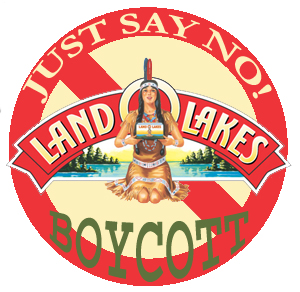
You have to cross off some stuff on your list and you have to do it NOW.
You must stop buying any products from Land O'Lakes.
OK, I know you're thinking that I've completely lost my mind and you don't want to take any rash action based on my word alone, so let me tell you why this is something that YOU will WANT to do yourself. Here is some information I just read both on the FarmWars blog and Foodmans Blogging for the Future:
"To produce its Round-Up Ready Alfalfa seeds, Monsanto partnered with a company called Forage Genetics International, which is a wholly owned subsidiary of Land O’Lakes dairy co-op. That’s right, Land O’Lakes stands to make a fortune from polluting our food supply with untested and unlabeled GMOs."
So there has been a call to action, an action that may actually make some waves in this economy in a way that our protests, petitions, and letters to Washington have failed to accomplish - a boycott of the purchase of Land O'Lakes products. And so that the impact of the action is not mistakenly blamed on our suffering economy or some other financial issue, it is also recommended that we just come right out and tell Land O'Lakes what we are doing!
"Send Land O’Lakes and other companies a clear message: HAY you — We’re FED UP with GMOs in our food supply!
And to make sure Land O’Lakes knows why its sales are down, contact its president and CEO Chris Policinski and let him know you won’t be buying Land O’Lakes products anymore because you don’t want genetically engineered food or animal feed:
Chris Policinski
President and CEO
Land O’Lakes
4001 Lexington Avenue
Arden Hills, MN 55126-2998
651/481-2222"
In addition, some fired up foodies have decided to share their feelings on the Land O'Lakes Facebook page. Not a bad idea if you ask me since that message will not only be read by Land O'Lakes people, but also customers who may not know about the partnership with Monsanto.
Do you still have that grocery list? Have you crossed them off yet? In the end, it is up to you, of course. However, if you believe in this cause and decide to boycott Land O'Lakes (as I will be doing - I just informed the husband before this writing), then please be sure to share your feelings with others you care about.
Back in 2006, I began my graduate degree in uptown Manhattan. The program I was in was designed for teachers, so it was intensive - we gave up three Julys of our lives to dedicate to school, classes ran from 8 to 5 on most days and one day of the week was 8 to 8 - we needed a place to eat, other than the cafeteria. Almost directly outside the doors of our school was a place called Chipotle that was, according to my classmates (who were from all over the US), the place to go for burritos and Mexican food. I had never seen one before, or even heard of one before, but after one quick dinner pick-up, I was hooked! Throughout the three years in the program our evening professors became very accustomed to the smell and sharing of Mexican foods in the classroom and, on occassion, joined in the ordering fun!
My obsession with Chipotle did not end with my time in grad school, it continued, and I then introduced it to my husband, so it became a family obsession. As I became more concerned with my food choices as a whole, I wondered if Chipotle was a typical fast food place and, therefore, have to be reconsidered as a suitable form of sustenance. So I decided to look into it and kept running into this one intriguing point: Chipotle kept referring to their food as "food with integrity." I felt this point might actually hold some potential, so I dug a little deeper.
Although Chipotle has been in business since the early 1990s, it wasn't until the close of that decade that the founder and owner of the franchise, Steve Ellis, learned the extent of the horrors in the factory farming industry AND decided to do something about it. This "food with integrity" tagline that each and every Chipotle carries with it is not just a good PR slogan - this company is FOR REAL. In this NIGHTLINE interview from 2009, you can hear Ellis describing his passion and work to earn this badge of "integrity":
Chipotle's website also gives a great taste of the company - from their menu, to their food philosophy, their interesting time-line and a bit more from Steve Ellis. There is also a store finder where you can locate the closest Chipotle to you and then, maybe, you can even order online (I haven't tried that feature yet, since it is a bit of a trip for me to get to any Chipotle!). I highly recommend checking out their "Food With Integrity" tab to find out not only what this company is doing for animal welfare and the environment, but how it also extends itself to its people - those who work for and with the company, I thought that was some really good stuff!!
Steve Ellis, the founder and owner of Chipotle, has definitely become another foodie-hero of mine. He has balanced ethics with economics in a country where too many have argued that one must always be compromised. While this is a pivotal part of Mr. Ellis' business, customers are not beat over the head with it - you can find the tag-line "food with integrity" on the menu, but, to be honest, it is easily ignorable - Chipotle is about good food, beginning to end, plain and simple. In fact, while getting together with a group of friends to take a Chipotle Trip to The City (this is what we call Manhattan, even though there are 5 boroughs in New York City, our home being in one of them), I started discussing the reasons why this was such a great place to support - most of my friends had no idea, they just thought it was a great place to go because it had tasty food (which is also a very compelling reason). The establishments themselves also feel like they are somewhat "responsible" as you can see the food being cooked, you select from fresh ingredients, all the packaging does seem minimal, and there is a disposal system in place for recycling beverage containers.
This September, while visiting my grandmother in the nursing home in New Jersey, my husband and I needed to run out quick to get something eat. We found a Chipotle. I was elated and then suddenly saddened - my diet had changed to gluten-free and dairy-free since the last time I had been to a Chipotle. I wondered, "What are the chances of this place, with flour tortillas and cheese and sour cream all over the place, being a safe place for me to eat?" I decided to check it out. I found, upon entering, right next to the menu, I smaller menu-looking pamphlet, with Allergen Information on it! When I looked up, smiling, from it I saw my husband asking for a manager to ask about gluten so I stopped him, "Don't worry about it. It's already covered." Such a simple thing to do, but I was grateful for it. And über-grateful that I could still have CHIPOTLE!! WOO-HOO!
So you might be asking yourselves right now, "What brought this up today?" Very simple. Last night I had the most delicious chicken burrito bowl in a Chipotle in Brooklyn. That was my dinner. It was yummy, it was satisfying and I was just thinking... everyone needs a little burrito, or taco, now and then, why not share the good news about a good company doing right by its employees, the animals, the produce and the farmers that all come together to make the meal?
I am now left wondering, who else in the food industry is moving in the right direction? If you know of any other dining franchises that you think deserve a shout-out or some recognition for their good deeds, please let us know who they are. I think it is extremely important to support those who are fighting for what we believe in - it builds on the competitive spirit in others, forcing them to ask, what are those companies doing to get all of that attention? Maybe we should do it too...
After reading a number of blogs and online discussions tonight on buying organic food for the family, buying organic feed for animals on the farm and many questioning the merits of doing such a thing when there would be such a financial burden attached to it, I began to really wonder to myself, "WHY is organic SO EXPENSIVE??" As I read post on top of post of people saying, I'd really like to, but we can't really afford it, I was coming undone. I wanted to write back: IT IS WORTH IT, but I steadied my hand realizing that these are easy words coming from someone who has only to buy food for her husband and herself... Will the same sacrifices be possible when we have a family? Will the sacrifices be enough to cover the cost of organic living?
As I thought about it more and more it seemed increasingly unfair that organic was not a viable choice for all. It also didn't make a lot of sense to me - didn't organic food have less stuff in it? Shouldn't less cost less? Alas, so it should seem, but we know business doesn't have to make sense, it only has to make cents!
I needed to get to the bottom of this, for my own complete understanding. I wanted to know what I was paying for really. I know that my intention is to pay for quality food, but I had a feeling that the real expense was coming from something unforeseen.
Manpower
One of the first things that our organic dollars go to is the manpower. Rather than rely on chemicals and pesticides to kill all of the weeds on a farm, when a farm is organic, they refrain from using these techniques. This does not mean, however, that they allow weeds to grow willy-nilly throughout their crops! In fact, people actually have to go pull out the weeds. This takes time and time = money.
...that seems reasonable to me.
It's Economics
Supply and demand rear their ugly heads into this discussion, driving our prices skyward. It seems that in organic farms have a smaller harvest than non-organic farms. They simply do not produce as much produce! Especially since the demand for certified organic foods is increasing, the prices are following suit.
...this is the unavoidable law of the capitalist world I live in, I guess.
They're On Their Own
Large, non-organic farms receive government subsidies to cover expenses such as pesticides, herbicides and corn. They also do not have to pay for the mess they make of the world around them. In both cases they are covered. If you are wondering where the government is getting that money to pay them, that would be from us, through our tax dollars. Organic farmers are paying for everything beginning to the end, out of pocket - so they put the cost in the product. ...this was the part I worried about.
I am sure there are a whole bunch of other reasons why organic is more expensive than non-organic, but it is this last issue that truly gives me pause. THIS is what we have to stop. We have to stop paying for harmful food. We have to stop paying for it with our money (through our taxes) and we have to stop paying for it with our health! One website that I used as a reference when getting to the bottom of this enigma brought up another very good point - if we truly calculate the dollars and cents spent on the two types of food, we may find that organic is not that expensive. Here is an excerpt from the site's answer to the question "Why is organic food so expensive?":
Some scientists have estimated that the use of just one agrochemical (methyl-bromide) contributes to more than 20% of the global ozone depletion. This in turn is estimated to double the incidence of skin cancer globally.
I think this point is a salient one and one we should all consider. Food should be healthy, it should be life-supporting and it should not put families in a quandary of physical health versus financial stability every time they think about putting food on the table.
At this moment I can think of two things that we can do:
Use your "capitalist vote" I have used this term before. In my eyes this is the most powerful thing we can do in a capitalist society - speak with your dollar. If you can't buy a whole meal in certified organic or local foods due to the expense, find one thing that you can buy this way and do it consistently. Ask your family members, neighbors and friends to make the same commitment and you will be surprised how simple it could be to make a noticeable change.
Support the Farm Bill 2012 I haven't looked at this in a couple of months myself because I was getting pretty overwhelmed by the prospect of the entire thing, but I just found a blog post by Lee Zukor that gives me a bit of encouragement to revisit it with a guide he helped to create! Read Lee's post at Civil Eats and you may get an idea of how important this is for us to support.
So while I am home sick (again!) today, I am thinking about lots of food conversations I had at work yesterday and over the remainder of my weekend (well, as much as one can think about things after waking up at 2pm!). Lots of information has been shared, lots of questions have been asked and in the process both my curiosity and skepticism have been piqued again... One thing keeps itching at me and clawing at me: being healthy and eating is becoming a pretty popular topic in this country as of late and because of that some "healthy" food options are becoming more readily available to the public as a whole. You may be asking, "Nicole, what is wrong with that?" and, at first, I would have said, "Nothing, that's great," but as I said, my inner skeptic has been wakened.
An example: bison meat/bison burgers. My husband LOVES burgers, I mean really, loves them and will order them anywhere. In fact, one of the signs to me that he was truly growing as a person was the first time the two of us went on a date, there was a burger on the menu, and he opted to order something else - it was a big deal for him. Anyway, while they are not always his first choice, they are still one of his comfort foods, so when he learned he had a high cholesterol, he was a little upset... until he read about bison burgers. He tried them, liked them, and has been happy with his substitution. Here is what, unprompted by any conversations of my recent skepticisms, my husband said to me last night, "You know bison burger? Well, I can get that just about anywhere now - health food restaurants, but also diners - all types of restaurants have it on their menus. Do you think that bison are getting treated like the other cattle because they are so popular?" And I thought... that's a really good damn question.
To piggyback this statement - what about soy? Not only has it always been a mainstay in the litany of ingredients on the sides of many of our packaged foods, but now it has been lauded as the key to the health and longevity of those in the Orient. We heard the stories, we wanted to try soy for ourselves, now it is everywhere - soy milks, soy ice creams, tofu, soy nuts, edamame I am sure the list goes on. Was it this level of demand that allowed/allows the GMO (Genetically Modified Organism http://www.ebfarm.com/WhyOrganic/library/Glossary.aspx#G_glossary) to continue to be processed?
So, the big questions these ideas (and others) keep swirling in my head:
how do you know when your "healthy" food has taken an unnatural turn?
who can you trust to ask about how to use your purchasing power as what I like to call a "capitalist vote" by BUYING the right kinds of products? AND
(scary question) when does the "capitalist vote" actually work against progress by making demand so high on the right product that a BIG business comes in, buys it up, takes it over and tries to ruin it?
I am thinking, still, that my one true power remains in going to a family farm to buy my products. In this way I am using my capitalist vote ($$$) to support not only a product, but a system.
If you have any other ideas, I would love to hear/read them!